Hair

“Not a sparrow falls without your Father knowing it. Even the hairs on your head are all counted.” (Jesus, trying very hard to teach us that God cares for us and we can live without fear.)

Under the heading of things that you learn as a child and then keep on the shelf for sixty years, I never really thought deeply about the hairs on my head being counted. I kept it filed under things you know if you happen to be omniscient. As in, you and God are at a party and someone asks, “How many hairs are on Jim’s head?” and God quickly answers, “126,422. Not too many in the crown area though.” And, everyone is amazed that the Creator apparently has the correct number for over seven billion people. I Told you I hadn’t thought deeply about this.

(Random thought: since there are over seven billion people on the planet and, per google, there are between ninety thousand and one hundred and fifty thousand hairs on the human head, the math would imply that there are thousands of people that have the exact same number of hairs on their head as I do. That never occurred to me. I wish there was some way I could nod at them or give them thumbs up when I pass them at Walmart. Now back to the original point.)

Turns out I had this particular quote by Jesus filed in the wrong place. Jesus’ point is not that God knows everything. Jesus’ point is that God cares about everything. When crisis comes, our fear doesn’t lessen because we believe God knows stuff. It lessens because we believe that God loves us and cares about what happens to us. Think about it. When you are in the ER, it’s comforting to believe that your care giver has a lot of medical information but what really calms you down is when they show you that they care. Jesus wants us to know that God cares. God is paying attention.

I love my wife dearly but when we were separated at the grocery store the other day, I couldn’t remember what color sweater she was wearing. I hadn’t bothered to pay attention. On the other hand, per Jesus, God knows how many hairs are on her head and he knows this not because he is all knowing but because he bothered to count them.

Like I said, I have known about God counting hairs since I was a little boy but this isn’t little boy stuff. The context for Jesus is that there is scary, hurtful stuff in the world and it will likely come our way, but we don’t have to succumb to fear because God is with us and knows what is going on.

Again, don’t miss the point. Jesus is not saying there aren’t things that are fearful. There are. There are tragic things, horrific things, and heart rending things. Even Jesus, in the midst of a torturous death cried out that God had forsaken him. But those weren’t the last words from the cross. His last words were words of trust and commitment. “Into your hands…” He was not afraid.

He was not afraid because he believed that very day birds all over the globe had breathed their last and God was present. He was not afraid because he believed that the God who cares about everything, down to the last hair follicle, would see him through.

That was true then for him. It is true now for us.
The Contemplative Way

There are a lot of tents in the Christian camp. Aside from the myriad denominations, there are other labels such as Evangelical, Social Activist, Traditionalist, Progressive, Fundamental, Orthodox, Liberal, on and on.

I’ve never been much of a label person but the tent I want to dwell in is the one where the Contemplatives live. I decided to make this official when I ran across this quote, “For the Contemplative, everything is important. Everything is sacred.”

The Contemplative way is ancient and its basic practices are:
– Prayer that makes requests known but also listens and is often simply silent in the presence.
– Reading Scripture and other spiritual writings in hope of being formed by them as opposed to simply being informed by them.
– Seeing without judging or grading. Paying attention. Seeing as is, seeking to be aware.
– Listening to the sacred story of others, especially those that often aren’t heard.
– Pondering God’s first language, creation.
– Seeking justice for all.
– Loving kindness, embodying graciousness.
– Remaining humble. Remembering, as Richard Rohr says, that your point view is simply the view from your point in the universe.
– Believing that God is found inside our lives. In our hearts more than in our heads.
– Living simply.

As I ponder this list, two things jump out at me. First, the realization that I am not a very good contemplative, I just want to be one. Second, this way of life does have political and social implications. This way of life pushes one toward nonviolence, restorative justice, doing for others as we would have them do for us on a local and global level, and toward gentle care for the planet.

Yep. I’ve never been much of a joiner and I usually resist labels but I think this is one I want to grow into. I’m guessing the way to do that is practice.

Friend of the Family

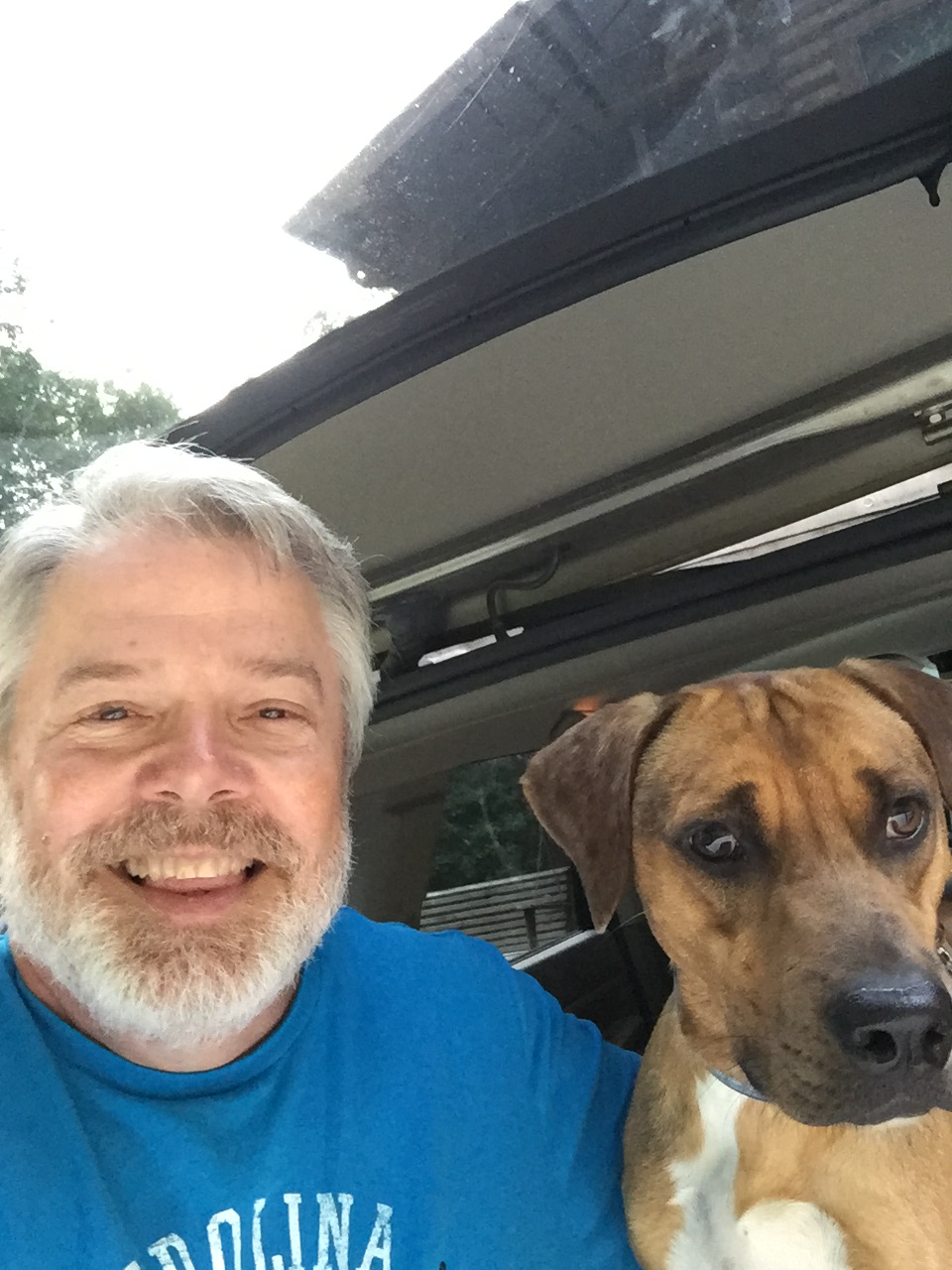
Jim and Gus


People who study such things say that around 12,000 years ago one of my ancestors (who is probably one of yours as well, Cuz) looked at one of Gus’s ancestors and said, “What a friendly puppy! I think I’ll make it a member of the tribe.” You could say that Gus’s family has been friends with my family for a very long time.

My daughter, who volunteers at the Humane Society, introduced me to Gus back in September. We hit it off immediately even though I had said repeatedly that I would never get another dog. Besides, we already had Lulu, a toy yorkie. Of course Lulu will tell you, “we” don’t have her, she is Kathryn’s. Anyway, when I met my guy I realized that I actually did want another dog and no offense to Lulu, one that weighed a little over five pounds. I wanted one that had a little spunk. One that I could do things with and since my spunk graph is slightly but persistently charting down it seemed like now would be better than later. So, I put in the adoption request, got my new partner and named him Gus, after the spunky retired Texas Ranger in Lonesome Dove. I am being sincere when I say that I believe that God brought Gus to me.

Every dog that has been a part of my life was a precious gift. I, like Mr. Bojangles in the Nitty Gritty Dirt Band song, after twenty years still grieve or five years or forty years, but Gus feels special. Perhaps it is because these days I am more inclined to see God’s presence in all creatures and less inclined to deny that pets can get deep in your heart and become a full member of your tribe. I love my dog.

I believe the feeling is mutual. I have proof of this from the internet. Gus does all the things that iheartdogs.com says that dogs do if they love you. Plus, I have the backing of the popular book, The Five Love Languages. Gus’s love language is clearly quality time. He likes to be with me. He is ecstatic when I come home after being gone just a short time, he dances when we are heading out for walk, jumps in the Jeep like we are going to Disney World when it’s just the recycling station, and tears down the steps to the basement so he can be a part of whatever adventure I’m on when I’m only going to the frig for a beer. Well, maybe it’s not quality time. Maybe it’s just time.

All this reminds me of the saying you’ve probably seen in gift shops or on social media, “My goal in life is to be the person my dog thinks I am.” I like that but I am not sure it actually captures the best part of Gus’s and my relationship. After all, based on the evidence available to him, Gus thinks about all I have going for me is that I occasionally take hikes and like being outdoors. But he loves me anyway.

On the other hand, I have observed Gus to be friendly to everyone, faithful, and constantly saying “I love you” (per Iheartdogs.com). He brings joy to those around him, and encourages exercise. None of this seems to require any effort on his part. It is who he is and he loves being who he is. Maybe a better goal for me is to be the kind of fellow my dog is.

Will We Be OK?

“Am I going to be OK?”

I can still clearly see her face; wide eyed, fearful, yet brave enough to ask the question. It was Kathryn an hour or so before our first daughter was born. She was beautiful, vulnerable, and very afraid. I leaned over, rubbed her forehead with the cool, damp cloth and said something along the lines of “Of course you will.”

I have relived that moment hundreds of times. I think of it whenever I want to ponder the most sacred scenes in my life. I was overwhelmed with love for the woman who was soon to be the mother of my child, grateful that I could offer some assurance when she needed it, and I think for the first in my young, charmed life acutely aware of the vast chasm between “of course you will” and “most likely you will.” I tried to hide it but we were both afraid, both wondering if things were going to be OK. Husband, wife, emerging child, life, uncertainty, fear, hope, no idea what was about to happen, etched forever in my memory.

The other day I was revisiting all this when it occurred to me that I often stop the video in my mind right there. It’s like we had that moment and what happened later that afternoon is unconnected to our time of fear and uncertainty. It’s as if it is two separate days. I guess a baby girl’s arrival is kind of a stand alone event.

But it is connected. It was the same afternoon. We were right on the verge and very soon we would be in a new life, a wonderful life. In one late fall afternoon we would go from fear and uncertainty to joy that literally had me jumping, punching, and shaking when I went to the locker room to change out of my scrubs.

I have come to believe that the memory of that incredible afternoon is my life speaking to me. I think it points to a holy message that is a recurring pattern in our journey with God. The truly miraculous meets us in the scariest places. Read that again. Remember that even Jesus wondered if he was going to be OK when he called out “My God, my God why have you forsaken me?”

There are indeed very scary places on life’s path, hard places, heart-breaking places. Sometimes we fall deeply into that chasm between “of course we will be OK” and “not everybody makes it.” But, somehow life and scripture teaches us that those times are not the end of the path, they are doors. Life is coming. Joy is with us even there, even when we don’t feel it. The divine, constant “Do not be afraid,” is present. Our daughter was making her entrance that fear filled afternoon and long ago on that terrible hill the God of Life was about to say, “Arise my Son” to the suffering man on the cross.

Will we be OK? It’s a fair question. Truth is, we may end a particular day not feeling OK but the deepest truth is reflected in that wonderful quote from Julia of Norwich, “All will be well, and every kind of thing will be well.”

Perhaps when we are most afraid it is a signal that birth, new life, is about to happen.

The Church’s Porch

As I ate my hot grill cheese sandwich in a little café in upstate South Carolina, I told a couple of my friends about a man I met when I was the pastor for a church in downtown Columbia. At this particular church, often during the day, people congregated around the front steps or sat on the stone wall along our driveway. At night they slept in shelters, tents, or sometimes behind the HVAC unit of our sanctuary. Michael was one of those folks.
One hot summer afternoon Michael knocked on the door of the office building with a simple request. He didn’t want money, food, or a ride anywhere; he wanted to know if I would let him take a nap on our porch because its cement, in addition to the porch’s overhang, was shaded by old oak trees and was “so cool.”
I thought about it for less than a second but I’ll confess that in that split second I wondered how it would look to potential church visitors as they passed and I remembered that choir practice was going to start in just a couple of hours but still, I quickly said, “Sure you can Michael. I’ll just have to wake you if you are still here when the choir members start coming.”
“No problem Rev. It’s just so hot and I am so tired. I just need a few minutes.”
He put his pack down, fluffed it a bit to transform it into a pillow, lay down on the concrete floor and closed his eyes. I quietly closed the door and went back to my desk.
About an hour later I figured I better check on him. I snuck up to the window, parted the blinds, and saw that he hadn’t budged. I looked at him for several moments, his matted red hair, thick auburn beard, worn army boots, and stained clothes. It occurred to me that there had once been a day when someone held young Michael in their arms and said things like, “It’s a boy!” “Oh look, he has red hair!” “He looks just like you.” “We are going to call him Michael.”
Perhaps a minister, standing in front of the people of God, held him, placed a hand dripping with water from the font on his forehead, slowly traced a cross, and said, “Michael, I baptize you…” He was beautiful. I wanted to kiss on him on his forehead and tell him that he was a wonderful child of God. I gently opened the door and told him it was time to wake up.
Michael was on my mind because two days before lunch with my friends I went to a Bible study at Haywood Street Congregation in Asheville, NC. When I walked in the lobby of this church which strives to be “a witness to include the most excluded,” there were three people lying on the floor because the recliners in the room where people often come to rest were full. I was glad for them. The mountains have started taking on a late fall chill and I imagined a dry, warm place to rest safely was no small thing.
I told my lunch friends about that and I told them about Michael. I told them that I had shared this story about me, Michael, and my epiphany in more than one sermon but I will tell it no more. Now it makes me sad. A little ashamed.
Now days I ask myself, why did I tell Michael that he would have to leave when choir practice started? Why would church members coming to sing about Jesus be a reason to cut short a child of God’s welcome rest? Why did I not ask him if he wanted to nap in the conditioned air that the HVAC unit provided? I have answers to those questions but none of them are particularly good.

The Holiday Table

Perhaps heard around more than a few holiday tables this time of year:
“Good lord, how much weight has she gained since I last saw her?”
“Do I think he drinks too much? Let’s just saw his ‘one day at a time’ is going in the wrong direction.”
“Don’t get me wrong, I love him and all but don’t you think things are better when he doesn’t come?”
“Before this last election I thought she was pretty smart.”
“He lets that girl walk all over him. It’s pitiful.”
“If she brings that woman, her so called wife, I’m not coming!”
All this and more said by folks whose hearts are wondering why their family can’t be more like the family in the Thanksgiving picture they saw on Facebook. It was twenty-first century Norman Rockwell. Every single person in that photo was beautiful, educated, employed, and kind to animals. Why can’t our family be like that?
Well, there may be a picture on Facebook like that but there ain’t no families like that. We’re all flawed, wounded, and hard to understand. Gerald May, the late Christian psychiatrist and writer, said, “A good definition of a sane person is someone you don’t know very well.” In other words, if we limit seating at the table to sane folks, it will be an empty table.
But if we invite and welcome the ones we need to be there, the table becomes full again because the mystery of it is that we all need each other.
We need our crazy uncle. Not just because he can fix the dishwasher but crazily enough, we need his crazy to make us, us. He was put in our life to teach us something and if we shut him out we will miss it. We will become a little more unbalanced ourselves because we didn’t figure out a way to make him a part.
Sure there are people who are not just irritating but hurtful and we need boundaries. But, compassion gives us the strength to resist dancing to their tune and it helps us hear and dance to our own.
It’s called life. It’s messy. But it is what it is and when we receive it as it is becomes deep, rich, and full. Real.
Happy holidays!
Oh, and a glass of wine may help.

Cancer Lessons

I am not sure of the exact wording but it was something along these lines, “Your scans look good and you are five years out. Congratulations, the chance of this cancer recurring is now less than ten percent.” When I heard my oncologist say that, it put a smile on my face; for three reasons.

First, it tickled me that my guy just can’t let go of doctor speak. “The chance of this cancer recurring” I get it Doc. All those other cancers are still out there and you aren’t guaranteeing anything. I understand that I’m not going to live forever. One day something is going to get me but I promise I won’t tell my family to sue you if anything bad happens.

Then there’s that business about being less than ten percent. Everyone always says that like it should feel like a sure thing. Not really. That’s what they said the first go round and it came back. Less than ten percent just ain’t as little as it used to be. You want to play the less than ten percent game with me? Let’s say I tell you that you have to be in your house tomorrow night at seven. You can be in any room you want. You can stand, sit or lie down but at exactly seven I am going stand in your front yard and shoot a high powered rifle through your house. Hey, don’t worry, there’s a less than ten percent chance that I’ll hit you. Still feel like a sure thing?

Of course, aside from my dark humor, brought to you by metastatic melanoma, the man did say, good scans, five years out, and the truth is my chances are good enough that if I were playing Texas Hold’em, I’d to go all in. Smile indeed.

So, it seems now is a good time to look back and acknowledge a few things I learned the past five years…

1) I learned to stay a little more in the present day. It’s cliché but all any of us truly have is today so don’t let it slip away due to worry about the past or the future. This came home to me one morning as I rode down the road wondering what my chances of survival were. Suddenly it dawned on me that perhaps the one certainty of my day was that I was not going to die from cancer on that day. There was nothing to say I was going to make it to supper but it wasn’t going to be cancer that got me. So, I decided to put my hospice orientation weekend on hold and be where I was, in the here and now. On that day I loved some people, tried to do good work, and said thank you a lot. Got up the next day and did it again.

2) I learned that I actually wasn’t afraid to die. (except when I thought about it too much) Mostly, I was just sad because what I realized is that I love being alive. I love my family. I love laughing. I love loving. So I put in an official request. I asked God to let me see my youngest grandson graduate high school. Kathryn gets mad at me about this one. She says my negotiating skills need honing and seventy-eight (in case he fails a grade) is too young. I tell her I’ll take an extension if one is offered. I’d love to talk to my grandson about whatever he chooses to do with his life, I want to meet his children, I’d like to go on vacation with a whole gang of grands and greats (on them). But a deal is a deal. If I can see him graduate I’ll go without whining. If it’s before then, I’ll trust next chapters to God but I’m still going to file an official complaint because I love this life and the people in it.

3) I learned that being brave isn’t much like bravado. It’s being able to keep moving. It’s caring about other folks, smiling, and doing your job. Mostly, it’s keeping an outward focus. Cancer wants to suck you inside yourself. It wants to scare you and make you focus on yourself and the lousy cards in your hand. The best way to fight cancer is to fight that. I learned this from the guy in the treatment room with me who may have weighed one hundred and twenty pounds and could almost walk. One day he shuffled past me as I lay there with some very expensive chemicals dripping in my arm. He smiled, shook his head, and said, “Hang in there.” In that moment his soul touched my soul. His path was much rougher than mine but he was encouraging, and by that I mean in couraging, me on my path. There were lots of folks like him along the way. I tried to be like them and as I did, I grew stronger. I grew braver.

4) Along with this I learned that we do get strength from others. You can feel prayers. Prayer shawls, meals, hugs, pats on the back, and listening ears impart super powers. Special sources of hope and comfort are the fellow survivors and their families. Over the course of five years the cancer family grows. Not everyone makes it. All become precious to you and transform your life.

5) Thanks to cancer I have become more grateful, more appreciative, more aware of the gift of a new day. That’s not to say that I don’t still piss some time away. I guess that is one of the banes of the human condition but it’s less, way less than it used to be.

6) Finally I learned a little bit about miracles. I don’t mean the miracles of medicine and prayer that wipe out cancer cells. Those are wonderful and they are real but I’m talking about deeper and more profound stuff. I have learned that God can take something as awful as cancer and make it a teacher, a blessing even. You see, it’s when we are at the end of our resources, when health, willpower, and even our human faith are depleted; that’s when the whole thing gets turned around and becomes a true conversion experience. That’s where we have the opportunity to discover that God is still with us and will never let us go. Never.

All of this is not to say that cancer is particularly fun. But if you have to go there, you may as well learn something. You may as well come through seeing a little more clearly, loving a little more dearly, following a little more nearly.

All in all it’s been quite an adventure.

Postscript: There is such a thing as survivor’s guilt. Like I said, some of my fellow travelers, people more talented, people who were needed more than me, didn’t make it. I carry them in my heart and have filed a complaint on their behalf.

Take, Eat

“Do you think the little children have any idea what they are doing?”

My friend was a little concerned about the United Methodist practice of inviting everyone to the table during communion. She had noticed that there was no membership requirement and partaking wasn’t reserved for those of a certain age. She seemed particularly concerned about the children.

I couldn’t help myself, my response was, “I doubt they do. I know I certainly don’t.”

Of course I’m used to doing a lot of things that I don’t understand. I don’t understand my desire to embrace the people I love but I embrace them anyway. I don’t understand why I feel inspired when I look at the sky but I look anyway. And, I certainly don’t understand how peace comes to my anxious heart when I pray but I pray anyway.

There are a lot of things I don’t understand and I really don’t understand very much about the bread and wine. About all I really know is:
– Christ is present
– When we gather at the table we remember the story, our story, that says we are lovingly created and faithfully cared for even when we fall short.
– That Jesus told us to take, bless, break, give, and remember. He gave these instructions on the night he was headed for the cross.
– That he used words like “all” and “many” and the whole thing begins with an invitation to all who seek.
– That our hope is that this eating and drinking will change our hearts, make us one, and give us strength to serve.

Now that I think about it, maybe I do get it on a deeper level than the three year old being carried in her father’s arms as she receives the bread from her pastor. After all, I’ve written a couple of graduate papers on this stuff.

Or, maybe, in that sacred moment, as she is gently carried, reminded that she is loved, and nourished by a broken piece of bread and grape juice, she gets it more than me.

Hymn No. 145

Even after more than three decades, I still find it hard to sleep the night before I preach. I attribute a good bit of that to the inner wrestling match that takes place as I struggle to change my heart’s prayer from something like, “Please let them be impressed” to “Let me glorify you and be a blessing for others.”

So, when I woke up at my daughter’s a couple of Sundays ago, I was tired and anxious. I had spent the night there because I had been invited to fill the pulpit for two churches near her house and I took that as an opportunity to add some family time to my weekend.

As I made my way downstairs, I was a little dismayed to discover that my eight year old granddaughter was already up and eating breakfast. I say dismayed because she is one of those folks that appreciates nothing better in the morning than the sound of people not talking and she is willing to express that preference. (Full disclosure, she may have inherited that from someone on her mother’s side of the family.) Anyway, when she looked up from her cinnamon toast, she gave me a look that confirmed my trepidation and conveyed that a vow of silence might be a good thing to add to my Sunday morning disciplines. Fine. Quietly I secured a mug of coffee and headed for the front porch.

The porch was a good choice for a nervous preacher. Morning was breaking, the cement was cool and refreshing to my bare feet, the day’s early glow was covering the neighborhood, and the rhythm the neighbors’ sprinkler just added to the feeling that things were being refreshed and growing. I settled into the rocking chair closest to the door and took that magic first sip of coffee.

Several birds were singing their morning songs but the most prominent voice was the crow. I guess calling a crow’s caw a song is a stretch but they sure seem to enjoy it.

There is a myth that says that the crows were once told by God that they could become any other creature they desired but they turned the offer down, choosing to remain crows. They must have figured that being clever, fairly tough, and able to fly was enough.

As I sat pondering crows and sermons, the front door opened and out came the granddaughter. She too was barefoot, with prettier feet, and she too took a moment to look around and take in the morning. Then, without a word, she walked past me to the next rocker. She pulled it a few inches closer to mine, took a seat, and continued her assessment. It occurred to me that it never crossed her mind that she wouldn’t be welcome in my sanctuary. I guess she believes me when I tell her that her Granddaddy will always love her.

As we sat and slowly rocked, I wondered if she remembered the hike we took a year or so ago, when I told her and her little brother to stand still and observe what was going on through each of their five senses. When we got to hearing she said that she heard birds but I asked her to go a little deeper, “How many birds?”

I wondered if I had ever told her about the crows turning down the offer to change into something other than what they were.

I wanted to say something but I knew speaking would ruin the moment. It was like a butterfly had landed in my hand and if I moved the wrong way it would fly away. I didn’t want it to fly away.

So we just sat; surrounded by creation, God’s first language. Enjoying the sound of people not talking and watching morning break.

“Praise for the morning…”

It’s Not About You

Phyllis Tickle, via her book, The Divine Hours: Prayers for Springtime, informed me this morning that on May 1 we celebrate the lives of St. Philip and St. James. This James is the one known as “James the Less.” She said that these two Christ followers “remained fairly obscure during their lives, preferring apparently to further the Church and not their own fame.” That observation concerning two of Jesus’ original disciples reminded me of a rather humbling moment of self-awareness I experienced a few years back.

The church’s basketball team had played that night and when I walked in the kitchen, after the game, Kathryn asked me if we had won.
“Nope, we lost.”
“What was the score?”
“I don’t remember but I had twelve points.”

Oops. I wouldn’t think it is a sign of a good team player to be sure what you scored but unable to remember the team’s score. Most likely, this applies not only to basketball players but to church folks, teachers, public servants, parents, spouses. . . let’s just say pretty much everyone who seeks to live with other people and somehow leave things a little better than you found them.

I’ll confess, throughout my career as a minister, I constantly had to remind myself of one the most important things a pastor can remember; it’s not about you. It’s not about you when you preach. It’s not about you when you counsel. It’s not about you when you lead.

One would think that would be a little easier to remember in retirement, when you are slowly drifting to the periphery anyway but I find the wondering how I’m doing and fretting over what my stats are, doesn’t quiet down so easily.

I’m still trying to live into the lesson the teacher gave the disciple when he told him to go to the graveyard and praise the saints there as highly as he could and then to insult them terribly. The disciple did as he was told and returned to his teacher.
“What did they think of your praises and insults?” the teacher asked.
“They didn’t seem to care.”
“Strive to care as much about whether people are praising or insulting you.”

They didn’t seem to care about their own fame, preferring to further the Church. Happy St. Philip and St. James day.